Wingtip Vortices
Formation of Vortices
When air flows over the aircraft wing, the shape of the airfoil creates low pressure above the wing and relatively higher pressure below the wing. The pressure differential results in a net force on the wing pushing it upward. This is called lift.
Air always flows from a region of high pressure to a region of low pressure. So, in the case of the aircraft wing, air tends to flow from below the wing to the upper surface of the wing.
The movement of air happens at the wingtip, where the airflow moves out from under the wing, swirls around the tip, and tries to enter the low-pressure region at the top. The circular motion that the air takes is called a vortex. Since it’s generated at the wingtip, it’s called a wingtip vortex.
The vortices aren’t just confined to the wingtip, though. The rotational movement of the air has inertia, and it continues to spread out behind the wingtip.
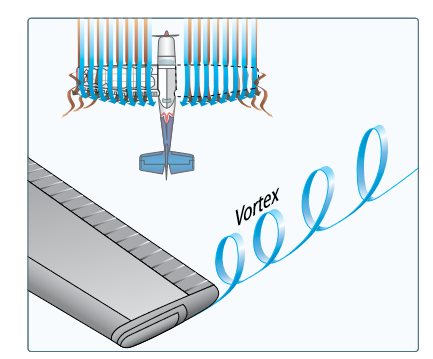
The vortices increase in diameter but decrease in intensity as time passes. These are called trailing vortices and they extend for quite a distance behind the aircraft.
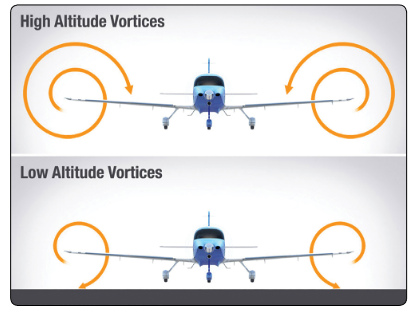
The wingtip vortices are more intense if the aircraft is heavy, slow, and is flying in a clean configuration.